By Nancy Dahlberg / ndahlberg@miamiherald.com
Will 2015 be the year virtual reality technology goes mainstream?
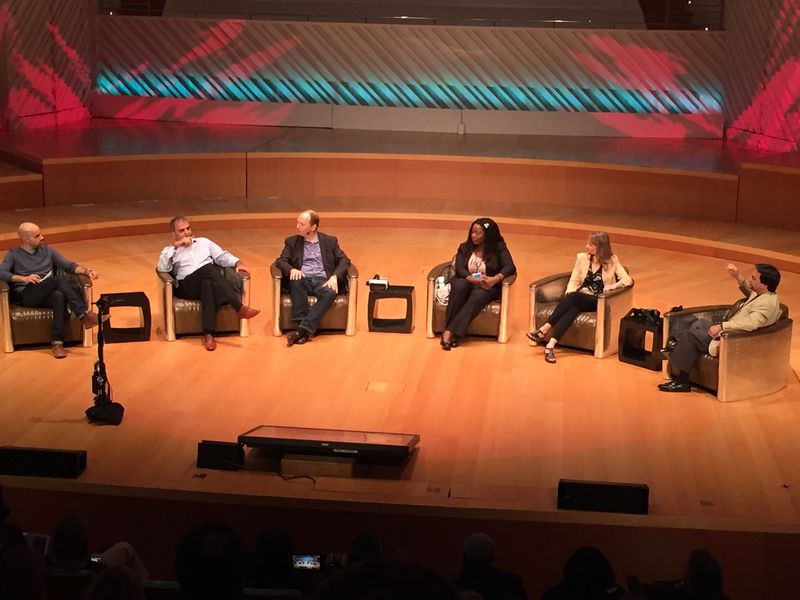
Industry experts speaking at The B.I.G. Summit this week in Miami Beach believe the time is right for more widespread adoption, and presented ways immersive experiences are already being used in industries such as automobile manufacturing, healthcare, sports and entertainment, retail and education.
The executives and entrepreneurs in the trenches of this technology, some for two decades, see a transformative year ahead because of the advances in quality coupled with prices of VR headsets coming down – there’s even a Google Cardboard (also available in plastic) for under $35. Samsung, Sony and other big brands are getting into VR in a big way, and much more content is being developed, they told the crowd of several hundred people at New World Center.
Much of the conference focused on what’s out there and what’s possible, and some of the innovation is grounded in Miami.
Many of the companies at the summit, some local and others from all over the world, are creating content for these technologies for a number of industries. “We are starting to see a lot of companies in the creative industries moving here and working with one another – this is an important evolution in building a technology ecosystem,” said Diane Sanchez, president of the Americas Council for the Creative Economy and a longtime technology executive in South Florida.
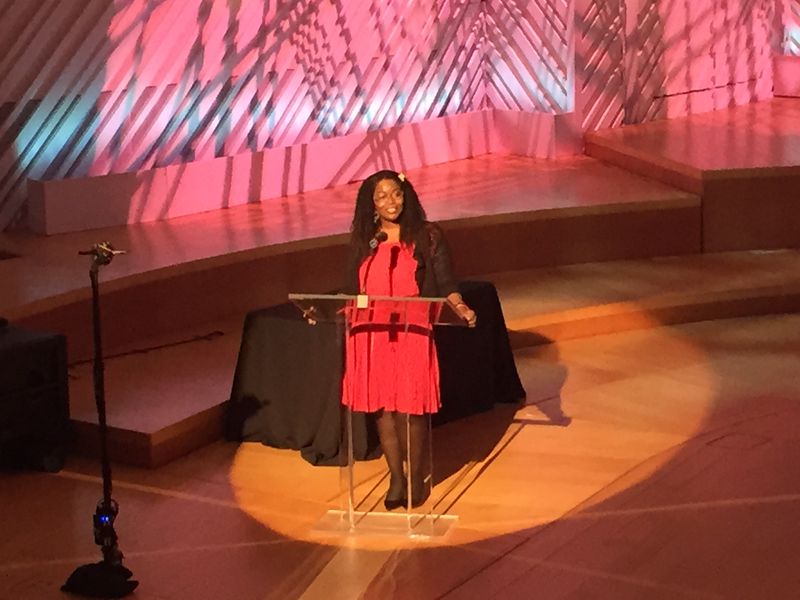
For instance, she said, Next Galaxy, which hosted the conference, has recently made South Florida its home. Founder Mary Spio (above) is working with Miami Children’s Hospital to create training courses using immersive technologies, said Dr. Narendra Kini, CEO of Miami Children’s.
“We want to develop the world’s first CPR course in a virtual reality environment,” said Kini. “This is a solution that is scalable – it can help millions of people so they are ready when there is a real emergency.”
Dr. Kini sees immersive technologies playing a big role in the next generation of healthcare training, an area dominated by the use of patient simulators now. Though the simulators are lifelike, the more advanced VR technology can completely immerse the students into an ever-changing medical procedure in a way no mannequin can, he believes. Could it help teach bedside manner, too, he asked?
Kini believes there are massive opportunities in healthcare for VR as well as other technologies. Not finding all the tools it needs, Miami Children’s dove in to develop some itself. “We took the risk in developing an incubator within the hospital,” added Kini. “We have three startups today. We plan to add another half dozen.”
Spio’s company works with brands to create content for VR and augmented reality, which has VR qualities but is grounded in the real world. Her company developed CEEK, a platform to access all sorts of content with one app, and CEEKARS, a 3D audio headphone that completes the VR experience, to “open up the doors to experiences that would be out of reach to most people,” said Spio.
Next Galaxy also partners with EON Reality, which has produced more than 7,000 VR applications for industry, education and edutainment and has offices all over the world. EON’s clients include Boeing, Microsoft, Lexus and Cornell University. Mats Johansson, co-founder and CEO, was named “Global Innovator of the Year” at the conference.
AvenuePlanet’s product puts you on the streets and in the stores of the world’s greatest shopping districts, bringing window shopping to a whole new level, said co-founder Sanjay Daswani, who was demoing the product. It’s launching soon and the London-based company has recently opened a U.S. base in Miami (I tried it out).
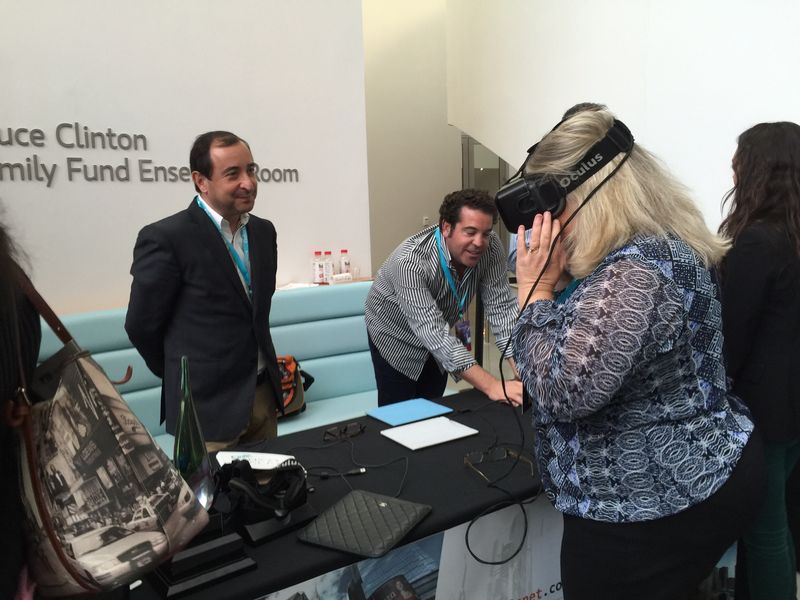
From Ford Motor Company’s multiple VR labs around the world, to the Golden State Warriors’ 12-acre ultra-high tech “campus” housing the team’s arena and more being built in San Francisco, to Lockheed Martin using VR for its advanced aircraft training, speaker after speaker gave use cases and what’s possible in the near future with the technology, including wearables. While Google recently shelved its Google Glass, Vuzix showed smart glasses that look like, well, glasses.
We have Palmer Luckey, a California high school kid, to thank for much of this. Luckey, a gamer, started buying VR headsets to see what the problems were and started building his own prototypes. Posting his plans on a message board attracted bigtime partner interest, led to important introductions and demos, and what would eventually became Oculus Rift, sold to Facebook for $2 billion, said Peter Rubin, senior editor of Wired.
The latest Oculus prototype shown at the Consumer Electronics Show has 360 degree tracking and 3D immersive audio, Rubin said. There are a number of exciting companies promising the next big thing with the technology, including Magic Leap of Dania Beach, he said. “I have not seen the technology but I have heard it is mindblowing.”
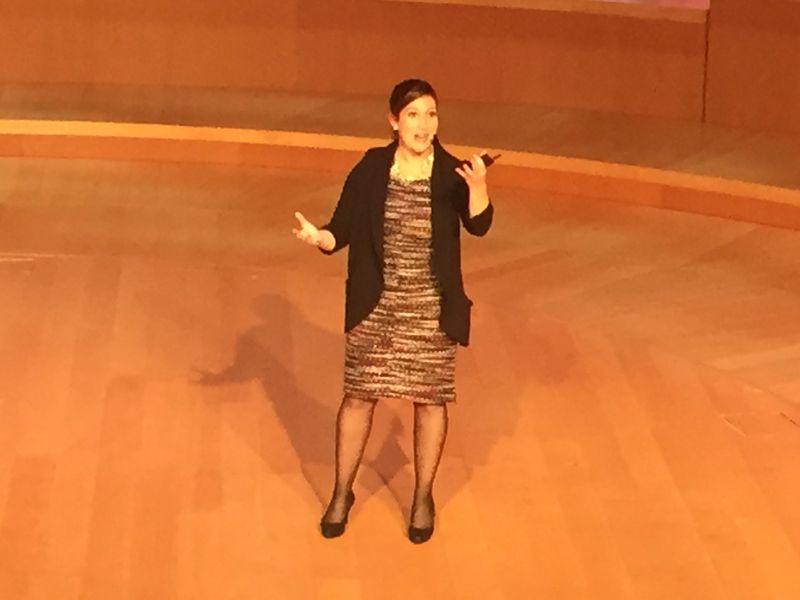
All this innovation doesn’t surprise keynote speaker Randi Zuckerberg (above), author of Dot Complicated and founder of Zuckerberg Media who directed marketing for Facebook into 2011. She believes that this is the age of the “entremployee,” and that companies should do everything they can to encourage innovation. Google, for instance, allows all its employees to spend a fifth of their company time on passion projects.
“Imagine what can happen if you gave your employees 20 percent of their week to work on passion projects?” she said. At Google, innovations from Google Adwords to Google Cardboard came out of that 20 percent.
Spio shared her own immigrant story at the conference, receiving a standing ovation. Coming from Ghana, her first job after landing in the U.S.: McDonald’s fry-maker. “When I got my first paycheck, I felt like a millionaire,” she said.
But joining the Air Force stoked the engineering fires that had always been in her, leading to her work for Boeing creating technology to digitally distribute motion pictures over the satellite and now heading her own company innovating in virtual reality and the Internet of Things. “See the world with a sense of wonder and make magic,” she told the crowd.
Follow Nancy Dahlberg on Twitter @ndahlberg.
Posted Jan. 21, 2014