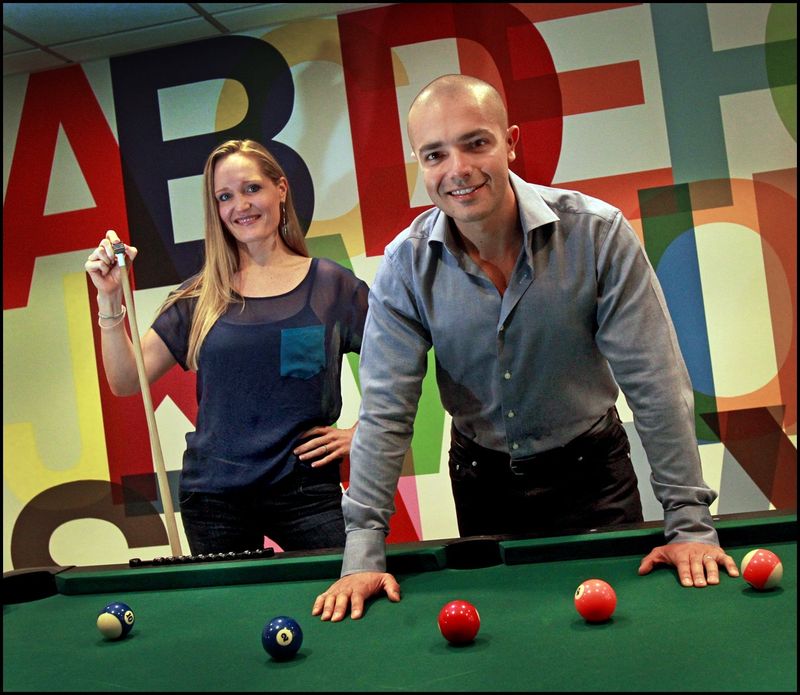
Andres and Nicolette Moreno are co-founders of Open English. Here they are shown in the company's Coconut Grove headquarters. Photo is by Patrick Farrell of the Miami Herald.
Andres and Nicolette Moreno founded founded Open English, a super fast-growing Miami company that offers English instruction through online classes, which is profiled in this week's Miami Herald Business Monday section. Nicolette shared some thoughts with me about what it's like to found a company with your husband, menorship and being a women in tech.
 Q. What has it been like to found a company with your husband? Can you share any strategies on how you make it work?
A. It's been beautiful, rewarding and a lot of work! What we have is uniquely complex, but works in all directions. In the early days, we didn't know the meaning of balance and we'd often work 20-30 days in a row without taking an afternoon off. At this stage we've been fortunate enough to have attracted a talented senior management team that allows us to get out of the weeds and spend more time thinking about long-term vision and the strategic direction of the company.
Working with your husband day and day out is an intense experience, but I've found that it fosters a deep sense of unity between us. We've been in the trenches together and needed to rely on each other's skills and commitment to get to the next stage. We don't have kids, but I'd imagine it to be a similar experience in the sense that you are both working full time to create the best future for your
child, and in our case, the company.
Q. You said your investors weren't totally keen on a husband-wife team at first? How did you turn them around?
A. In the early days, some investors took pause in the fact that we were married. This dynamic shaped our work ethic by demanding that we go above and beyond to continuously prove yourselves to colleagues and investors. Still today we keep the habit of giving each other feedback as we drive back home from work. We really don't cut each other much slack during these daily sessions, which is valuable for our professional advancement but tough to turn off once we get home. We are still
working to improve this; hopefully we'll get it right in the next "release" of our marriage. :)
Q. Do you have a mentor and if so how has he or she been helpful?
A. Yes. I've had several people that believed in me before I believed in myself.
Mike Hooper (former boss) has been my rock for the last decade. Funny enough, we end up talking more about life than work. He's been at the crossroads with me in some of the big decisions that've shaped who I am today. I can call him day or night and he always helps me gain clarity.
Two of the people that have most influenced me are John McIntire, our Chairman, and Thomas Wenrich, our COO. What I've learned from John is the power of bringing people together, as well as how to deal with adversity. From Tigre, how to get things done and how to protect the castle.
Q. What advice do you have for other women entrepreneurs?
A. The advice I give to other women entrepreneurs is to look at our challenges as opportunities. It's
certainly a challenge to be a woman entrepreneur because there are fewer of us out there and the start-up ecosystem is dominated by men, all the way from programmers to venture capitalists. Having said that, that's also our biggest opportunity because women have a unique optic on a host of social and professional issues that have not been solved yet.
The same is true for Open English. U.S. investors often ask why no one created an online English
school before we did. Our answer is always that if U.S. entrepreneurs would have had to learn English as a second langage, there would have been a number of competitors in our space well before our time. Our advantage was simply that we had personal insight on our market opportunity.
Check out this Geeky Beach video that features Nicolette and other successful South Florida tech entrepreneurs -- of the female kind: http://geekybeach.com/miami-tech-scene/geeky-beach-women-in-tech/
Following is the profile on Open English that was published in this week's Business Monday.
Profile: Open English expands across Latin America
BY JOSEPH A MANN JR., josephmannjr@gmail.com
Back in 2008, Open English, a company run from Miami that uses online courses to teach English in Latin America, had just a handful of students in Venezuela and three employees. Today the company has more than 50,000 students in 22 Latin American countries and some 2,000 employees.
 To fund this meteoric expansion, the founders of Open English — Venezuelans Andrés Moreno and Wilmer Sarmiento and Moreno’s American wife, Nicolette — began with $700. Over the last six years, the partners have raised more than $55 million, mostly from private investment and venture capital firms.
Their formula for success? The founders rejected traditional English teaching methods in physical classrooms and developed a system that allows students to tune into live classes every hour of the day from their computers at home, in the office or at school, and learn from native English-speaking teachers who may be based anywhere. Courses stress practical conversations online and the company guarantees fluency after a one-year course, offering six additional months free if students fail to become fluent.
“We wanted to change the way people learn English,” said Andrés Moreno, the 30-year-old co-founder and CEO, who halted his training as a mechanical engineer and worked full-time at developing the company with his partners. “And we want students to achieve fluency. Traditionally, students have to drive to an English academy, waste time in traffic, and try to learn from a teacher who is not an native English speaker in a class with 20 students.”
Using the Internet, Open English offers classes usually with two or three students and a teacher, interactive videos, other learning aids and personal attention from coaches who phone students regularly to see how they are progressing.
Courses cost an average of $750 per year and students can opt for monthly payments. This is about one-fifth to one-third of what traditional schools charge for small classes or individual instructors, Andrés noted.
“We work at building confidence with our students and encourage them to practice speaking English as much as possible during classes,” said Nicolette Moreno, co-founder and chief product officer, who met Andrés in Venezuela while she was working there on a service project. “Students are taught to actively participate in conversations like a job interview, traveling and talking on a conference call,” said Nicolette, who previously lived in Los Angles, worked with non-profits to create environmentally friendly products and fight poverty in emerging markets, and was head equity trader at an asset management firm. “Students need to speak English in our classes, even though it is sometimes difficult. They learn through immersion.”
Open English has successfully tapped into an enormous, underserved market. Millions of people in Latin America want to learn English to advance in their jobs, work at multinational companies, travel or work overseas and understand the popular music, movies and TV shows they constantly hear in English. Many of them take English courses at public and private schools and learn little if any useful conversational English. While students at private schools for the upper middle class and wealthy often learn foreign languages extremely well from native English-speaking teachers, most people can’t afford these schools or courses designed for one or two students.