By Peter Kovach
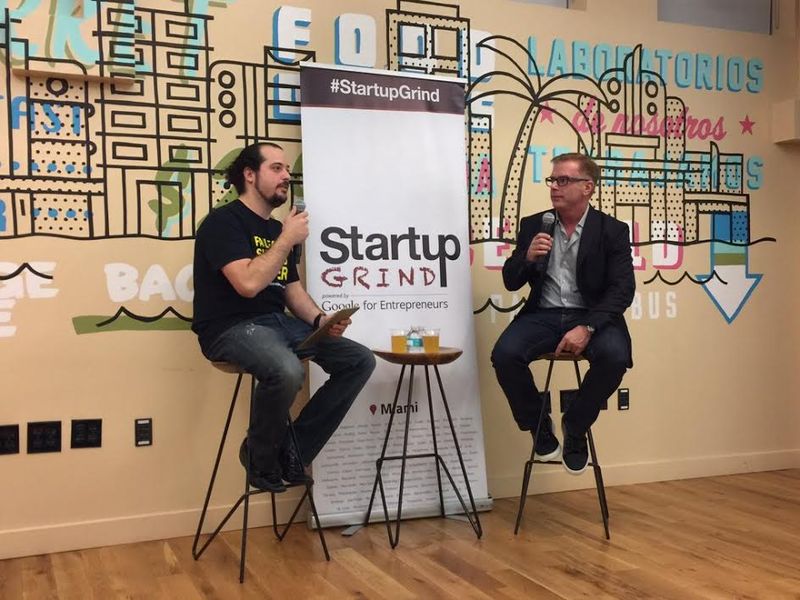
Mark Kingdon is a three-time digital CEO, company founder, board member and tech startup investor. Throughout his career, he's transformed Fortune 500 companies and startups through digital marketing, customer acquisitions and e-commerce, which accelerated their growth and increased their profitability. Last montn Jason Ibarra, of Startup Grind, sat down with Mark (pictured above) for a fireside chat at WeWork @ Lincoln Rd. They discussed Mark’s transformative career, starting with his creative beginnings at UCLA to his current work as a tech investor. Mark gave great lessons to the packed house on his experiences as a CEO and from his experience as an Investor.
* The Complete Package - Especially in early-stage investments, you are not just investing in an idea, you are also investing in the founder. So which one is more important? Both! Mark mentioned that a good idea is only as good as its founder. If the founder is not reliable, unwilling to listen to critique, has poor leadership skills or other character flaws, he may be discouraged investing in the company because there are serious concerns about who is running the company. Likewise, if a founder is a great person, extremely reliable, but their business has no merit then there will be no investment. For an investor, it is essential to believe both in the idea and the person who will materialize the idea.
* Communication Is Key - Besides making a return on his investment, Mark believes the best quality a founder can have for an investor is communication. Mark has dealt with various personalities and finds that he has the best relationships with the ones who communicate clearly and consistently. Mark has dealt with founders who struggle to present updates at board meetings and it has caused a large amount of frustration. On the contrary, Mark has invested in companies where the CEO after each month sends out a report on the current status of the company. This is a great trait, because it shows the founder is reflective and wants to make the best decisions.
* Priority Over Urgency - Founders face countless problems in any given day. The key is prioritizing problems by importance over urgency. For startups, everything is urgent but not everything is important. Mark believes that Product Vision, User Experience, Customer Traction and Investor Relations should be the key focuses for every startup in that order. If there are any problems with any of those areas, they supersede any other issues that exist and should be addressed immediately.
* Do Your Research - When contacting an investor, your product should speak for itself. It should be able to easily address the problem it's solving. More importantly, understand why you are contacting any specific investor. Find something other than money as the reason for reaching out. Make sure the investor can be an asset to the growth of the company and offer some sort of guidance. Finally, if you get a chance to present, ask the investor for their honest opinion on your venture. They can be a resource regardless if you get a yes or no.
* Honest Self-Valuations - When it's time to value your company, be REALISTIC. Many companies, even pre-product and pre-revenue, tend to drink a little bit too much of their own Kool-Aid. Not every company is Facebook. It's mandatory to have realistic expectations, based on your market and the economic trends. It's okay if you reach in your valuations, but you shouldn’t go to moon and back unless you want to get laughed at.
* Pivots Aren’t Cheap - Starting a business is risky. It requires large amounts of money and even larger amounts of time. More often than not, businesses will fail. However, if you are able to read into the trends, have a committed team, loyal customer base and a strong set of investors, you can pivot to success. Pivoting is expensive and there no guarantee it will work, but if you believe you can be successful and take the company in a new and successful direction, then pivot. Mark recalls how Fab.com, a company he invested in, pivoted from a gay social network to an exciting e-commerce site. The move helped Fab grow at an unbelievable rate.
Mark is currently an angel investor and his fund is Quixotic Ventures, which means "exceedingly idealistic; unrealistic and impractical" -- appropriate for early stage investing. Mark, who works out of Building.co, examines over 1,500 companies a year. Some of his early-stage investments include: Twitter, OfferUp, Sellbrite, Fab.com, Refinery29, Everypost, Sktchy and HYP3R (the last three from South Florida).
Next up for Startup Grind Miami: Brandon Timinsky of GasNinjas on Jan. 12 at WeWork Miami Beach. More info here.
Peter Kovach is a recent graduate from Loyola University of New Orleans. He moved to Miami to be a part of the rising tech scene and is currently an associate at building.co.