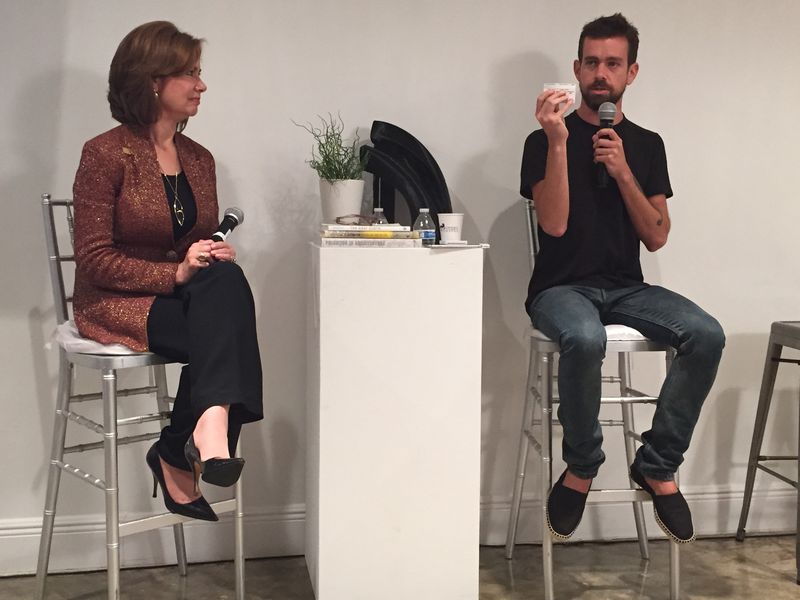
Payment technology may not be a topic that would draw a small-business crowd -- except when the speaker is Square CEO (and interim Twitter CEO) Jack Dorsey.
Dorsey, co-founder of one of the world's leading payment technology companies, joined U.S. SBA Administrator Maria Contreras-Sweet in a free public event Thursday morning held at the FIU College of Architecture + The Arts Miami Beach Urban Studios and sponsored by Rokk3r Labs. The objective: to get out the word about major changes in payment security coming Oct. 1 and how small businesses can prepare.
"Sixty-eight percent of small business have been hacked, they have been victims of cyber security fraud," said Contreras-Sweet. "Effective Oct. 1, the credit card companies say you need the chip reader because they are changing the security. We want to get the word out."
Dorsey demonstrated the present technology and why hacks have been relatively easy and explained what is involved in making the switch.
The bottom line, he told small businesses: Now, if you run a fraudulent card, banks absorb the costs. Starting in October, if someone pays with a fraudulent chip card, and you’re not set up with the new authenticated payment devices (whether it is Square's or one of its competitors) after Oct. 1, "you will be on the hook for fraudulent transactions. The banks won't have your back."
"Technology doesn't have to be complicated, it doesn't have to be inaccessible, it should be something that just works" he continued. "Our industry hasn't moved fast enough in pushing this so we are working with the SBA to make sure first and foremost sellers know this is coming and there are a string of solutions to address this, Square is just one. ... The important thing is bringing more security, more safety to transactions."
Dorsey grew up in St. Louis, Missouri, and co-founded Square with Jim McKelvey, now a Miami resident and founder of the LaunchCode apprenticeship program. Dorsey also shared some stories about growing up with entrepreneurship -- his father started a pizza restaurant and his mother later ran a coffee store.
What he's learned: "Entrepreneurs are not necessarily born with these skills, they have a do whatever it takes attitude to learn what they need to get to the next step and then there is a new challenge. I never had dreams of being a CEO, I had dreams of getting the world communicating in a very free and empowering way."
As for founding Square in 2009 in San Francisco, Dorsey said he hated the cumbersome credit card system and said he saw how it could destroy families. You have to ask the questions, why is it this way and then go after the answers, he said. "Our purpose at Square is to make commerce easy."
The co-founder of two of the most well-known tech companies in the world also told the mostly small-business audience: “The choice to stay small is just as admirable as the choice to go global.”
Dorsey said he is particularly proud of a couple of stats about Square and the companies Square serves: Fifty-six 56 percent of the small businesses who use Square are owned and run by women, and 75 percent of Square’s employees report to three women in the executive ranks.
Contreras-Sweet, a former banker, shared some information about SBA programs and products, including the new LINC on sba.gov that eliminates the need to fill out dozens of loan applications. When you enter answers to 20 questions online, banks will get back to you within 48 hours with what they can offer, she said.
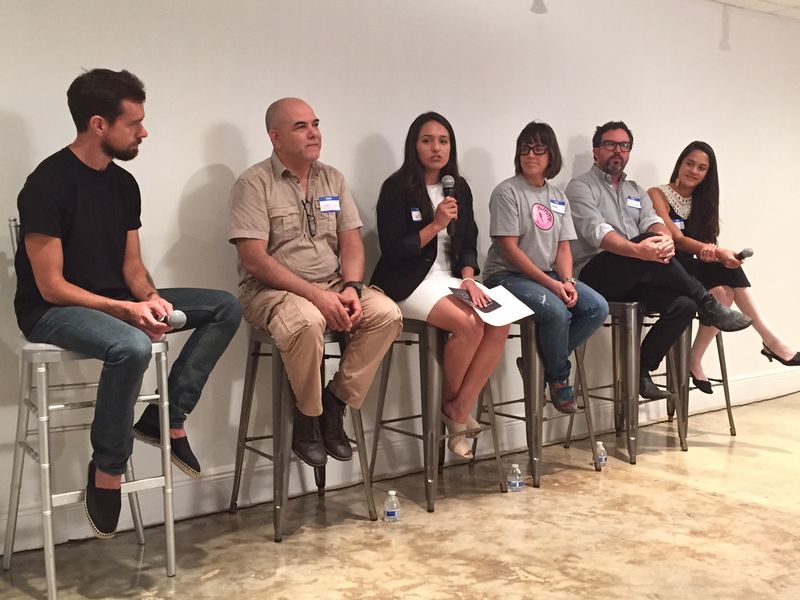
Near the end of the program, Contreras-Sweet and Dorsey brought up four local small businesses to briefly share their stories: Panther Coffee, LuLu's Ice Cream, Sugar Yummy Mama and Wynwood Warehouse Project.
Sorry, no talk about retaking the reins at Twitter or if/when Square may go public.
Follow Nancy Dahlberg on Twitter @ndahlberg