By Nancy Dahlberg / ndahlberg@miamiherald.com
Like the entrepreneurs it supports, Florida Atlantic University’s entrepreneurship hub for students and the community is very much a startup, too.
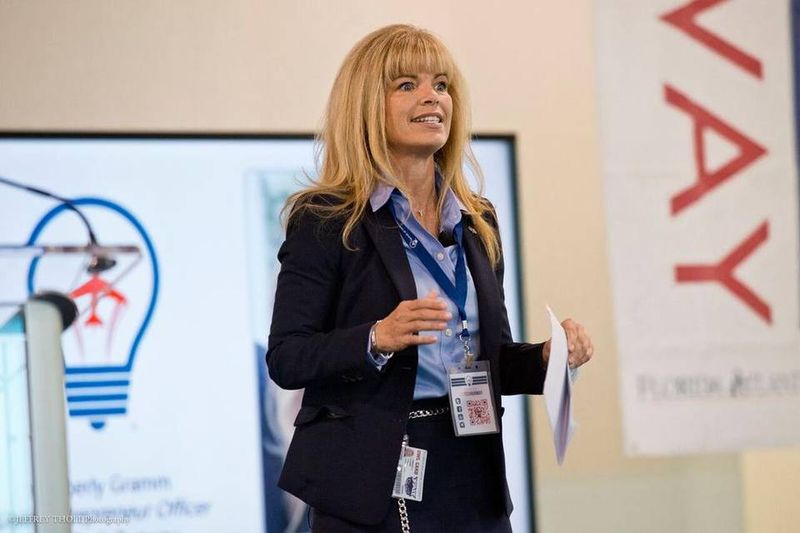
Tech Runway launched just a year ago. Its second accelerator class is underway and a third will be joining in the fall. But for Kimberly Gramm (pictured above), Tech Runway’s co-founder and associate vice president, it has been a six-year journey, and she has big dreams for the entrepreneurship center.
Tech Runway’s physical space next to the Boca Raton campus and executive airport is impressive — and unfinished, but ready for possibility. The 27,500-square-foot warehouse, where hurricane glass windows were once made, is now an open canvas. Most of the large garage doors have been replaced with glass to let the natural light in and watch the planes taking off. There is plenty of open space for events, and 15 work areas have been glassed in to create areas where resident startups can brainstorm with their teams on whiteboards, practice pitching, meet clients or hold meetings with their board of mentors. A 5,000-square-foot section off to one side is the “Tech Garage,” which hosts high school and college students weekly for robotics. Gramm envisions a full-blown maker space to come there. Once a year, engineering students build an electric race car from scratch in the space (a garage door was left so it can get in and out). Open rafters present possibilities of a mezzanine for more creative meeting areas — the sky’s the limit.
“We are putting together renderings and talking to architects to build out the space so that it becomes the hub we envisioned it to be,” said Gramm, while giving a tour of the facility. “The idea is to be a home for Tech Runway companies as well as a place for FAU to prepare innovative minds to become an entrepreneurial pipeline to Tech Runway.
“Exposing the high school and university students to this space is really important to us. You get students applying their STEM learnings in robotics programs, creating prototypes, even building electric race cars that compete. Spaces like this allow the mentors, the investors, the entrepreneurs and the students to have these creative collisions.”
Gramm was hired about six years ago to develop an entrepreneurship program. She started as the director of the Adams Center for Entrepreneurship with a handful of programs including the FAU Business Plan Competition.
“That was really a proof of concept,” she said. “What we found is what the marketplace wanted to see was more support and resources to entrepreneurship being driven by the university. The idea was to create an internal ecosystem, a gateway to launch.”
At Tech Runway, companies get a real-life curriculum in customer acquisition, developing a minimal viable product and attracting first round capital. Tech Runway gives each company a $25,000 grant, a 16-week bootcamp and collaborative workspace for a year, she said.
Tech Runway also provides structure and connections. Companies develop a series of milestones with their mentors whom they meet with weekly, and they don’t pitch to investors until they are ready. Tech Runway helps them get their first sales. After about a year, Tech Runway companies will typically graduate, once their lead mentors agree they have met their milestones. But the space is continually being restocked because there will be two classes — Tech Runway calls them Venture Vintages — accepted each year going forward. It is also growing its programming for students and supporting faculty startups.
“The university is committed to making this a longstanding resource for our community,” she said.
We spoke with Gramm recently at the Tech Runway offices. Here are excerpts of that conversation: