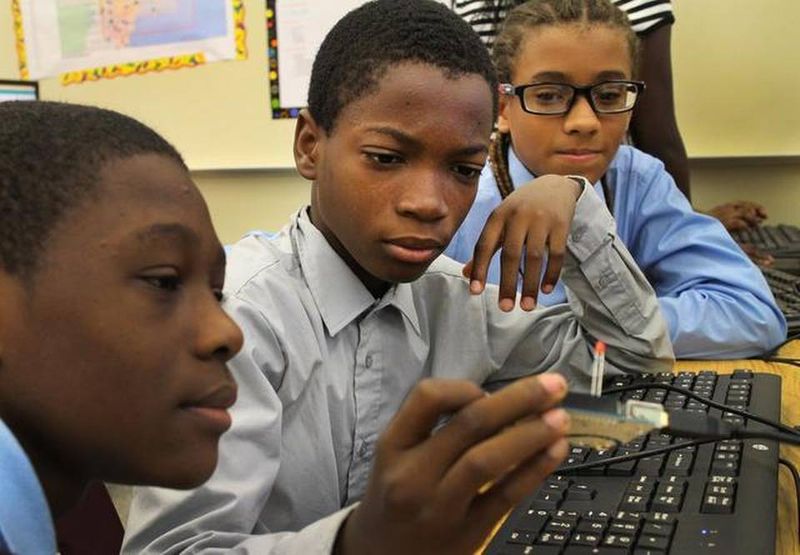
Christopher Jules, Steeve Jean-Louis and Janiel Adames, all ninth graders at iTech @ Thomas A. Edison Educational Center in Miami.They are working on basic coding with the hope of being able to one day build their own small satellites that they can remotely control in space and conduct science experiments by studying the data collected by the satellites.C.W. Griffin/Miami Herald Staff
By ALEXI C. CARDONA / acardona@MiamiHerald.com
As a child, Kiman McIntosh suspected the moon was made out of cheese, and he dreamed of launching himself into space to find out for sure.
While Kiman, 14, may not be able to take a bite out of the moon, his childhood dreams of space exploration are not entirely out of reach.
Students in the Geospatial Information Systems academy at iTech at Thomas A. Edison Educational Center in Miami, a magnet high school that just launched this year, can soon explore outer space from their classrooms. These students are learning the basics of coding and computer programming to build small, cube-shaped satellites that will be launched into low Earth orbit by astronauts on the International Space Station. Sensors inside the satellites’ payload connect students to the universe by taking pictures and collecting data about the earth’s composition, temperature, weather and light.
Using these sensors, students can study warming trends, map and predict thunderstorms and measure levels of radiation over certain areas of the earth’s surface. Students decide the type of information they want the satellite to collect and receive online reports from Ardusat’s Mission Control.