Today's guest post is by Susan Amat, executive director of UM's Launch Pad, who wrote this column for Business Monday. What's your view?
By Susan Amat
 Two weeks ago I returned from Geeks on a Plane (GOAP): Latin America. Hosted by Silicon Valley-based venture capital firm 500 Startups, GOAP involved 35+ technology entrepreneurs and investors traveling to different cities to be immersed in their tech entrepreneurship ecosystems. Reasons to join the 10-day adventure were varied: Some were looking for deals in which to invest, others were contemplating opening a foreign office or moving their businesses overseas.
Through the generosity of the Knight Foundation, my comrades from Miami and I hoped to experience the developing ecosystems in Mexico City, Sao Paulo and Buenos Aires, searching for inspiration and answers in our efforts to support and grow the Miami community. By leaving Miami, I saw the opportunities and issues we face in a new light.
In Mexico City, the importance of transparency was enforced daily. There are several funds investing in early- and growth-stage businesses in Mexico, a small community where everyone knows one another. Over several conversations, each speaker separately cited that “outsiders trusting their
operations and interests” was the key to their abilities to raise, invest and maintain some level of cooperation with all interested parties (entrepreneurs, government, industry, etc.).
Interestingly enough, the money seemed to be telling the story of the opportunities in Mexico rather than the entrepreneurs. The investors painted a picture of ethical business dealings, government support and committed investors who are there for the long run. I’ll return to this point in a moment.
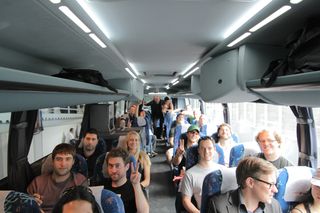 In Sao Paulo, the entrepreneurs were center stage, sharing their experiences in their burgeoning economy. The challenges of starting and growing a business in Brazil were suffocating. Barriers included an extremely high cost of living (higher than NYC), wages comparable to the U.S. but with 100–125% tacked on for benefits, and unionization of all employees with stringent laws and policies dictating their activities. (Photo by Davide di Cillo)
The entrepreneurs, especially Predicta, a unique tech-focused advertising agency and consultancy, were total hustlers (I mean that as a HUGE compliment) and I know are destined for international greatness. The community support system — especially Brazil Innovators, a nonprofit that organizes and coordinates most of the events that is led by Bedy Yang — is focused on education and making connections.
With all of the roadblocks, Brazil’s entrepreneurs are bonded in their common struggle, and the
community is one of the most collaborative I have seen. In our four days in Brazil, events were always co-sponsored by multiple groups and participants were supportive regardless of other allegiances (school, chamber, organizations, etc). They put aside differences to find ways to work together — win/win.
Buenos Aires was amazing. From multiple accounts, the scene sprouted organically through Palmero Valley meet-ups — first drawing a handful and now up to 800 attendees for the larger events. My new friends at Mercado Libre (Ebay for LatAm) and Catmandu Studios (animation studio extraordinaire)
provided inspirational stories that any community would envy. Mercado Libre’s high-rise offices overlook the garage where the business was started. Catmandu is creating the first feature length 3D animated film about soccer, called Foosball. Its team has both top animators from around the world and local animators cutting their teeth — and training the next generation. The goal is to build the animation industry in Argentina from scratch. I feel like that is what we are doing here as a bunch of individuals. We need one focused goal.
I traveled with Brian Breslin and Davide Di Cillo, Refresh Miami organizers who host monthly events drawing hundreds of tech professionals. We reflected on each GOAP event together, from different perspectives, but always arrived at similar conclusions. Things I took for granted, like connectivity
and ease of doing business, are now strengths as we tell our story to the world. But the new understanding I have of our challenges has been hard to swallow.
While a lot of groups do things “together,” there is very little collaboration in this space. This must change; and not just working together so we can say we are, but real value-added, synergy creation — connecting excellence. If we want to be a world-class city, we must demand excellence from
all of those who represent us to the world. This touches upon the transparency issue that Mexico City has identified as its biggest challenge. How does the outside world view our business community and our government? Zero tolerance for unethical behavior or are shady individuals still accepted as prominent members of our community?
The collaboration I saw in Brazil set the tone for a call to action in our own community: WHO is doing WHAT the best and HOW do we get THOSE people working together on ONE focused goal for the community?
Buenos Aires went from a handful to hundreds of animators in less than two years, and educational institutions are starting programs to support the interest, bringing in new blood from all over the continent. The government is providing incentives to support the creation and growth of more studios so these students will be able to get experience and jobs to stay in the community. One community, one goal.
What Miami-Dade College has done with the Miami Culinary Institute is a great example. Innovative, playing on Miami strengths, and pulling in the local stars (thank you for Tuyo!). What else is happening in Miami that is world-class? If we want to make Miami amazing, it is about giving the best entrepreneurs, leaders and programs access to whatever they need to hit it out of the park. If
we don’t, they will leave and we can’t afford more brain drain.
Our region is the most transient in the United States. We won’t keep them here if we keep supporting mediocrity. And we won’t attract new awesome entrepreneurs, inventors, creatives, technologists and leadership to feed our growth unless the community embraces entrepreneurs and established businesses are involved in supporting new ideas and products. This happens when decision makers in government and established businesses champion the entrepreneurial community as problem solvers, risk mitigators and job and opportunity creators. We need more investors who offer value beyond financial support, who understand predatory terms kill a startup’s long-term potential.
We need to celebrate individuals and companies who lead with ethics and transparency — and want to grow Miami. They have a higher calling, a mission to stimulate growth, jobs, opportunities and make South Florida a better place to live, work and play for all of us.
For more information about our GOAP trip, please visit the Knight Foundation blog, which also includes video interviews with our fellow travelers shot by Brian and Davide. Also, see an earlier post about GOAP here.
Susan Amat is co-founder and executive director of The Launch Pad at the University of Miami, which has helped hundreds of entrepreneurs develop skills, make connections and launch businesses. She also leads Startup Florida. Follow her on Twitter: @SusanAmat