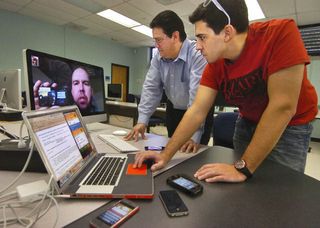
 Raymond Gonzalez, a Florida International University senior, is developing an iPhone application called Pet Finder that will allow users to browse the dogs and cats at the local animal shelter or request an animal for adoption. He is also part of a team creating mobile apps that track bank failures, issue alerts about earthquakes and organize homework assignments.
It’s a well-calculated effort to learn as much as he can about mobile technology as quickly as possible. “My goal is to make all these apps free and open source while using the knowledge gained to build my startup company after graduation,” said Gonzalez, who is majoring in information technology.
Whether he starts his own company or works for someone else, Gonzalez is preparing to be a player in a high-paying, sizzling new industry, one that might provide the United States with a big opportunity to increase its exports in coming years.
While the overall economy still lags, the “app economy” has created nearly 500,000 jobs in the United States since 2007, when there were none. Some universities have begun retooling their curricula to meet the growing demand, including FIU, which was recently ranked No. 2 in the nation for the number of computer science bachelor’s degrees bestowed.
Steven Luis, director of technology and business relations at the School of Computing and Information Sciences at FIU, teaches an iOS development course, where Gonzalez and other students have been developing apps that solve “real world challenges” for organizations such as the Humane Society of Greater Miami and 4KIDSofsfl.org, Luis said. He also mentors an FIU senior class project, which is developing an events app for the Miami Beach Visitor & Convention Authority’s Open API
initiative.
Also, on Thursday nights, about 20 mobile developers, designers and other app enthusiasts meet at AppDojo, a collaborative innovation group at Florida International University. Students from all disciplines — as well as members of the public — are welcome to participate in the free program.
Founded by Luis and alumnus Carlos Ordonez in August, AppDojo is an open space where students and others team up to build their innovations and meet with mentors. It’s inspiredm by hacker spaces — “here they have the resources they don’t have in their apartments,” said Luis, who also brings in speakers.
At AppDojo, Gonzalez, who already has about 10 years of experience in web development and works for a Tampa-based company, paired up with Michael Olivero, an adjunct professor at FIU and a senior software architect at Inktel Direct. Olivero had already published one app but wanted to expand his learning by creating small functional apps that explore different features of the iOS platform. Olivero
created a spreadsheet with 19 functions, and he and Gonzalez are going about developing as many apps as they can in the 19 areas.
In the way that FIU’s AppDojo crosses disciplines, Florida Atlantic University offers a collaborative course called Android App Design and Project Management, which will be offered again this spring. Last spring the class, made up of business, engineering, graphic design and anthropology majors, developed seven apps related to health and safety. For one pair of students in the class — Mathew Hudson and Andrew Stadtlander — their class project became a core focus of their app-development company, Stadson Technology in Boca Raton. With nine people on the team so far, Stadson is already creating jobs.
Stadson’s app called HelpN, which will be marketed to universities, helps students in distress alert first responders with both the student’s location and health information and other data the responder might need. FAU plans to beta test the app on its campus soon and Stadson is also marketing it to FIU, the University of Miami and the University of Central Florida on its road to going national.
“We’re moving, we’re moving fast. We’re really trying to make a difference,” said Hudson, Stadson Technology’s CEO. “This is a huge leap for schools and we will continue to improve the product to better help the universities.”
Read my full story on the “app economy” here.
Find out more about local organizations and events:
AppDojo: An idea-stage hacker space, where developers, designers and entrepreneurs can find team members and get mentorship. It’s at FIU but free and open to all. App-building enthusiasts can request to join AppDojo’s Facebook group at http://www.facebook.com/groups/AppDojo/ and general meetings are posted here: http://www.facebook.com/AppDojo.MIA
Hackathons: Several are coming up, including HackDay with a $50K prize Dec. 8-9 (HackDay.co) and the AT&T Mobile App Hackathon Dec. 14-16 (http://mobileappmia2.eventbrite.com)
Code Retreat Miami: Dec. 8. A software development workshop improves your coding skills in web or mobile. http://coderetreatmiami.eventbrite.com
App Awards: Feb. 22. The App Awards celebrates web and mobile apps where the judge is you. http://appawards2012.eventbrite.com
More events: miamitech.org and miamitechevents.com
(Photo by Miami Herald photographer Tim Chapman shows FIU student Raymond Gonzalez and Steven Luis, a director in FIU's School of Computing and Information Sciences, working virtually with Michael Olivero, an FIU adjunct professor who is working with Raymond on several apps and is shown on the computer screen.)